Advanced Materials paper published
Tailored vapor deposition for wafer-scale epitaxial 2D magnetic CrCl3 was published in Advanced Materials, with theory support for experiments on 2D magnetic material synthesis.
PhD in Physics · Computational Materials Scientist
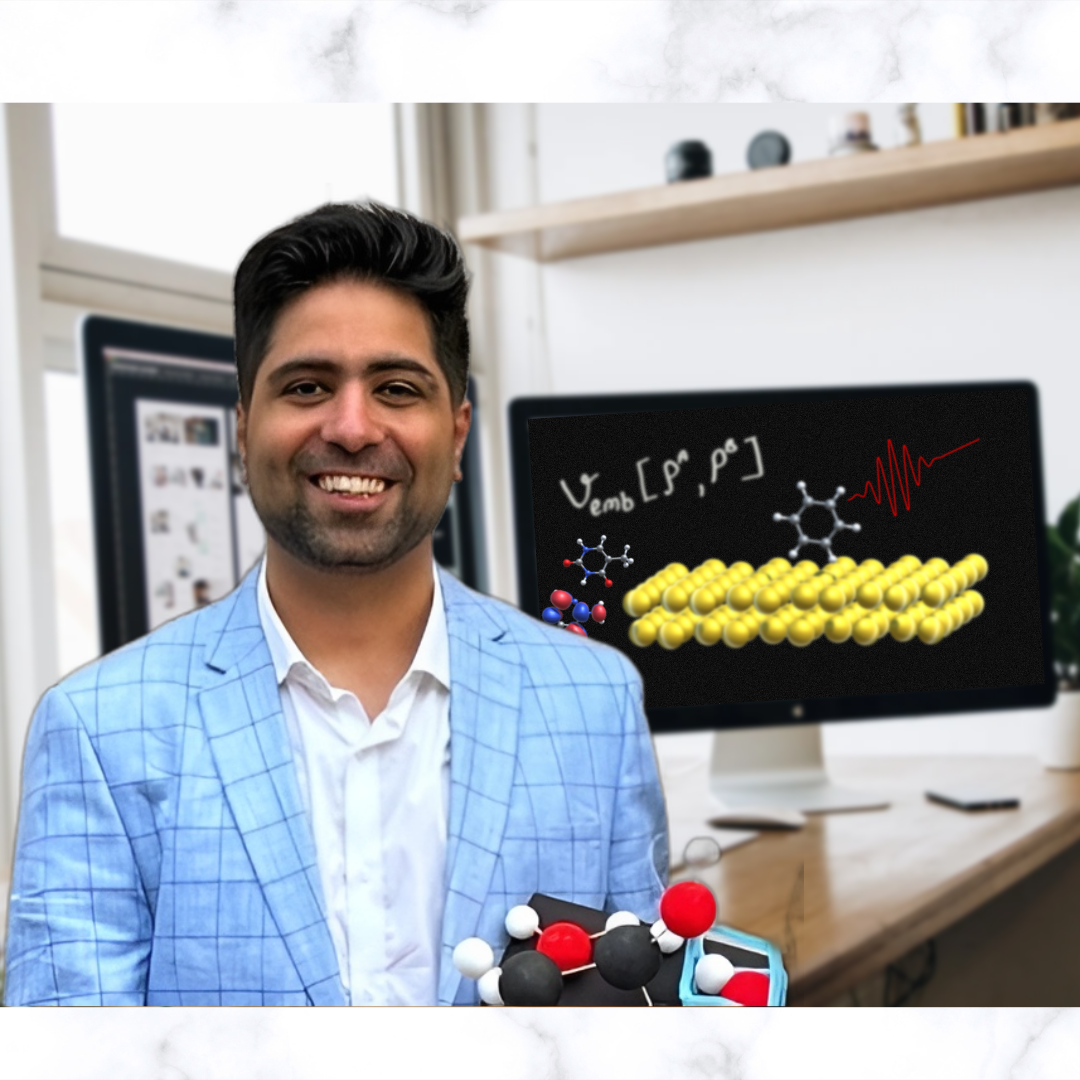
I develop quantum embedding methods, machine-learned interatomic potentials, and computational tools to understand light–matter interactions, thin-film growth, and the electronic structure of complex materials — at the atomic scale.
Updates
Tailored vapor deposition for wafer-scale epitaxial 2D magnetic CrCl3 was published in Advanced Materials, with theory support for experiments on 2D magnetic material synthesis.
Won the Best Oral Presentation Award for a talk at the IISc Chemical Engineering Symposium 2026.
PyFock, a pure-Python MIT-licensed DFT code with molecular integrals and exchange-correlation terms, was released.
A review of DFT for molecular and periodic systems in TURBOMOLE was published in The Journal of Physical Chemistry A.
Phys Whiz reached 20k subscribers with tutorials and lectures on physics, computational materials science, and numerical methods.
MLIP Playground launched for running, benchmarking, and testing machine-learned interatomic potentials.
An article on GW/BSE-in-DFT and CC2-in-DFT optical gap calculations for ionic solids was published in JCTC.
Presented DFT-based embedding for periodic systems at the TURBOMOLE Users Meet Developers Conference at the University of Oxford.
Joined IISc as a postdoctoral researcher in the Chemical Engineering Department.
Cube Suite, a web app for processing and manipulating CUBE files, was released.
Defended the PhD thesis with the summa cum laude grade.
RIPER-TOOLS launched for creating TURBOMOLE RIPER input files from CIF, XYZ, POSCAR, Materials Project, and PubChem sources.
Background
I am a postdoctoral researcher in the Chemical Engineering Department at the Indian Institute of Science (IISc), jointly advised by Prof. Ananth Govind Rajan and Prof. Sudeep Punnathanam. My current work focuses on developing graph neural network (GNN)-based interatomic potentials for simulating thin-film growth processes such as CVD and PVD.
Previously, I obtained my Ph.D. (Physics) from Friedrich Schiller University Jena, Germany, with the highest distinction of summa cum laude, under Prof. Dr. Marek Sierka. During my doctorate I developed and implemented advanced DFT-based quantum embedding methods coupled with wavefunction and real-time TDDFT approaches, contributing new capabilities to the TURBOMOLE quantum chemistry package.
Beyond research, I am deeply invested in scientific outreach: I run the Phys Whiz YouTube channel (~21k subscribers, 3.6M views), build open-source computational tools, and mentor students worldwide.
Focus Areas
Developing DFT-based embedding methods coupled with wavefunction theory (WFT) and RT-TDDFT to achieve high-accuracy excited-state and adsorption energy calculations at reduced cost.
Training graph neural network (GNN)-based interatomic potentials on high-fidelity DFT data to enable large-scale atomistic simulations of thin-film deposition (CVD/PVD).
Studying high harmonic generation and optical excitations in molecular thin films using real-time TDDFT and GW/BSE approaches within periodic and molecular frameworks.
Investigating reaction pathways and energy barriers for CVD/PVD using DFT, nudged elastic band (NEB), and ab initio molecular dynamics (AIMD) simulations.
Building performant DFT codes, neural network libraries, and GUI applications — optimized for parallelization and GPU acceleration — to serve the research community.
Creating YouTube tutorials, web and Android apps, and blog content to make computational materials science accessible to students and researchers worldwide.
Trajectory
2024 - Present
Developing GNN-based MLIPs for thin-film deposition and materials design, with DFT, NEB, AIMD, and molecular dynamics workflows.
2019 - 2024
Summa cum laude. Thesis on density functional theory based embedding for molecular and periodic systems.
2019 - 2024
Implemented quantum embedding and real-time TDDFT capabilities in the TURBOMOLE RIPER module using Fortran and Python.
2016 - 2018
Specialized in nanoscience, ranked third, and completed DFT-based research that led to publications.
2013 - 2016
Acharya Narendra Dev College. Ranked second with 87.08 percent and received the DC Arora scholarship.
2014 - Present
Writing tutorials, building apps, and creating physics outreach content through BragitOff.com and Phys Whiz.
Recent Work
Direct Nanoscale Mapping of Band Alignment in Single-Layer Semiconducting Lateral Heterojunctions
Nano Lett., ASAP Article (2026), published online April 13, 2026
Tailored Vapor Deposition Unlocks Large-Grain, Wafer-Scale Epitaxial Growth of 2D Magnetic CrCl3
Advanced Materials, e14405 (2026). † contributed equally
J. Phys. Chem. A 129, 39, 9062–9083 (2025) Highly Viewed
Optical Gaps of Ionic Materials from GW/BSE-in-DFT and CC2-in-DFT
J. Chem. Theo. Comput. 20, 21, 9592–9605 (2024)
J. Chem. Theo. Comput. 19, 20, 6859–6890 (2023) Highly Cited
Resonance Effect in Brunel Harmonic Generation in Thin Film Organic Semiconductors
Adv. Optical Mater. 2203070 (2023) On Cover Top Viewed
J. Chem. Theo. Comput. 18, 11, 6892–6904 (2022) Cover
Code Development
Python DFT
Pure-Python DFT code with molecular integrals and exchange-correlation terms.
Project siteMLIP Web App
No-code web app for running, testing, and comparing machine-learned interatomic potentials.
Launch appQuantum Chemistry
Input generation tools for the RIPER module of TURBOMOLE from structure files and databases.
Open toolVisualization
Molecule and crystal visualizer for publication-quality structures and animations.
Project pageCUBE Files
Web app for processing and manipulating CUBE files from quantum chemistry programs.
Open appMore Tools
Android apps, file converters, basis-set tools, DFT embedding demos, and ML demos.
All code projectsGet in Touch
Whether it's research collaboration, outreach, or just a conversation about computational physics — I'd love to hear from you.
[email protected]